The Nostra Ætate Lecture Series
The Nostra Ætate Lecture Series built on the 40th anniversary of the Second Vatican Council’s document on interreligious dialogue, as well as on other similar initiatives like the Pacem in Terris lecture series.
Nostra Ætate: An Overview
On October 28, 1965, the Second Vatican Council issued a statement like one never before which called for increased relations with non-Christian religions. This revolutionary document, named Nostra Ætate for the first two words in its original Latin text and translated as “In our age,” marked a huge transformation not only in the history of Jewish-Christian relations, but of relations with Islam, Buddhism, Hinduism, and many others. Prior to this time, relations, with these other faith traditions, at best, consisted of mutual ignorance and conflict. With their historic statement near the close of Vatican II, Catholic bishops from around the world created a new situation of openness and dialogue.
Nostra Ætate has perhaps been most important, however, to the Jewish people. The document supports as the chosen of God as well as illustrates Christianity’s connection to Judaism. It also says that the death of Jesus cannot be blamed on all the Jewish people of Jesus’ time or today. Since the document was issued, members of each faith community have begun to learn about one another’s practices, theology, and history. This includes recognizing the historical relationship between the two religions, educating about the tragic events of the Holocaust and anti-Semitism, and establishing cooperative programs between Christian and Jewish agencies. Jews and Christians now study each other texts and traditions, work together in social justice programs, and can simply enjoy one another’s company as friends. Increased dialogue does not mean giving up one’s own identity and faith, but rather gaining a basic respect and understanding of the other.
Nostra Ætate is credited for laying the groundwork for further advances in interreligious dialogue both in the Catholic Church, Eastern Orthodox Churches, among Protestants, and among many other world religions.
The Lecture Series
Nostra Ætate, the Declaration on the Relation of the Church to Non-Christian Religions, continues to revolutionize the Catholic Church’s approach to the Jewish people and members of other religions. From 2006 through 2013, Georgetown University hosted a series of lecturers from various traditions and experiences examine both ancient and contemporary questions of interreligious understanding.
The Nostra Ætate Lecture Series was proudly co-sponsored by the Office of the President, the Berkley Center for Religion, Peace, and World Affairs, the Catholic Studies Program, the Center for Social Justice Research, Teaching and Service, the Office of Mission and Ministry, the Prince Alwaleed Bin-Talal Center for Muslim-Christian Understanding, the Program for Jewish Civilization, and the Woodstock Theological Center.
The Inaugural Lecture Series, 2006
Rev. Fr. Thomas Stransky, C.S.P.
Rector emeritus, Tantur Ecumenical Institute for Theological Studies, Israel
Nostra Ætate and Beyond
- Part 1: The Genesis of Nostra Ætate: How the Changes of Vatican II Included Jewish Relations and Interreligious Dialogue
October 4, 2006 - Part 2: Nostra Ætate and the Unfolding of Vatican II
October 12, 2006 - Part 3: The Questions of Nostra Ætate: Asked and Not Asked; Given and Not Given
October 18, 2006 - Part 4: On the Frontier between Bethlehem & Jerusalem: A Paulist LivingNostra Ætate
November 2, 2006
Subsequent Lectures
2006 – 2013
- Seeking Understanding in Our Age
Dr. Susannah Heschel, Eli Black Chair in Jewish Studies, Dartmouth College, New Hampshire, U.S.
November 28, 2006 - The Catholic Church and the Jewish State (first lecture)
Rev. Fr. David-Maria Jaeger, O.F.M, J.C.D., The Church and Israel Public Education Initiative, Rome, Italy
February 15, 2007 - Interreligious Dialogue: Seeking Understanding in Our Age
Prime Minister Kjell Magne Bondevik, President of the Oslo Center for Peace and Human Rights, Former Prime Minister of Norway (1997-2000; 2001-2005), Pastor, Evangelical Lutheran Church of Norway (1979- )
March 2, 2007 - Multi-Religious Action for Peace: Nostra Ætate in the Public Sphere
Dr. William Vendley, Secretary General, World Conference of Religions for Peace
March 27, 2007 - Contemporary Jewish Responses to Nostra Ætate
Rabbi David Rosen, KCSG, President of IJCIC, the International Jewish Committee
May 2, 2007 - The Catholic Church and the Jewish State (second lecture)
Rev. Fr. David-Maria Jaeger, O.F.M, J.C.D., The Church and Israel Public Education Initiative, Rome, Italy
February 15, 2008 - The State of Religious Dialogue: Forty Years after Nostra Ætate
Dr. Sayyed Hossein Nasr, University Professor of Islamic Studies, George Washington University
April 3, 2008 - Challenges to Islam, Christianity, and Judaism in Today’s Global Crisis
Rev. Fr. Hans Küng, President, Global Ethic Foundation; Professor emeritus, Ecumencial Theology, University of Tübingen
November 20, 2008 - Peace, Dialogue, and Coexistence in Bosnia and Herzegovina
His Eminence Vinko Cardinal Puljić, Archbishop of Sarajevo, Bosnia and Herzegovina
February 3, 2009 - Dialogue or Proclamation: Rethinking the Church’s Mission
Professor Gregory Baum, Professor Emeritus, McGill University Faculty of Religious Studies
November 17, 2010 - Interreligious Dialogue: Before, During and After Vatican II
Archbishop Kevin McDonald, Archbishop Emeritus, Archbishop of Southwark, England
April 30, 2012 - Achievements, Challenges and Experiences in Catholic-Jewish Relations
Rabbi David Rosen, International Director of the Department for Interreligious Affairs, American Jewish Committee
November 6, 2012 - Pope Francis and the Jewish Community of Argentina
Rabbi Abraham Skorka, Rector, Seminario Rabínico Latinoamericano, Buenos Aires
November 4, 2013
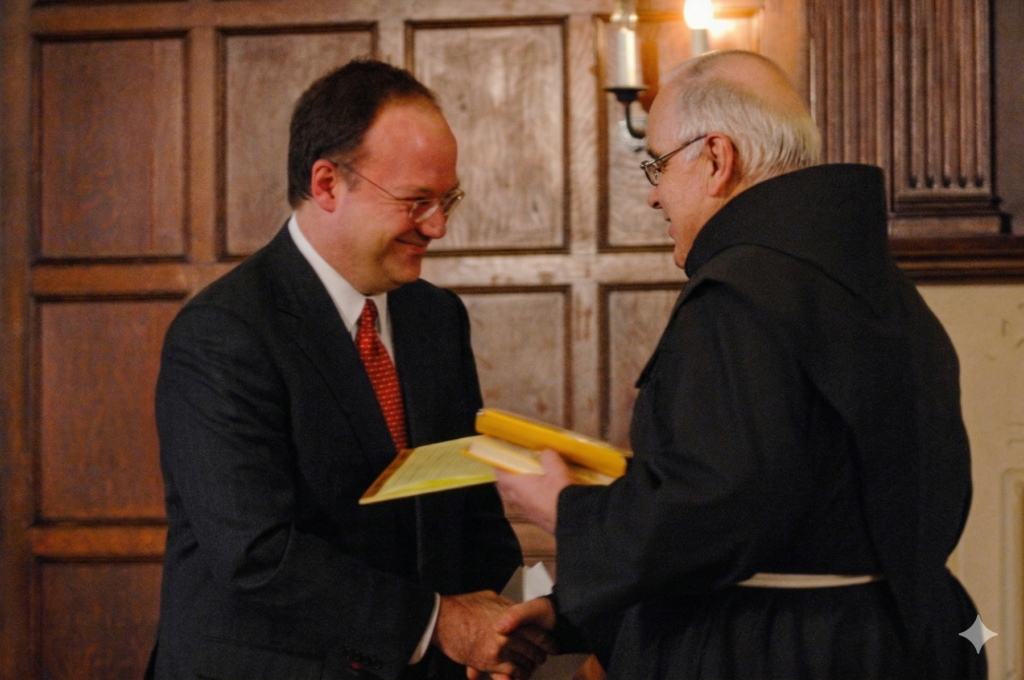
Then-President DeGioia greets Rev. Fr. David-Maria prior to delivering his “The Catholic Church and the Jewish State” lecture, February 15, 2007.
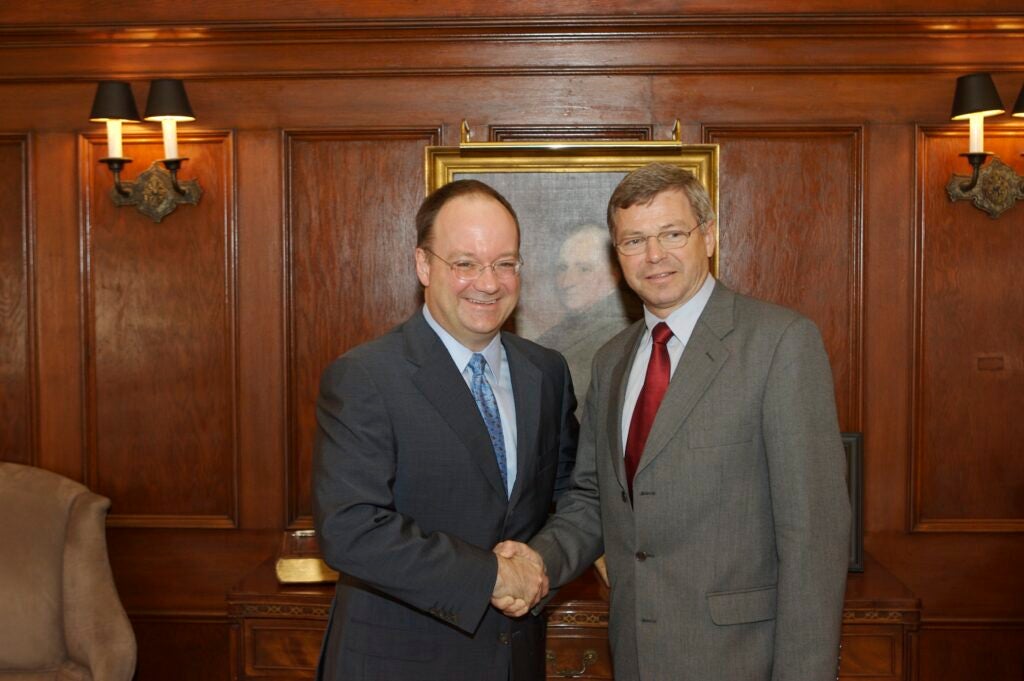
Then-President DeGioia and Prime Minister Kjell Magne Bondevik, March 7, 2007.
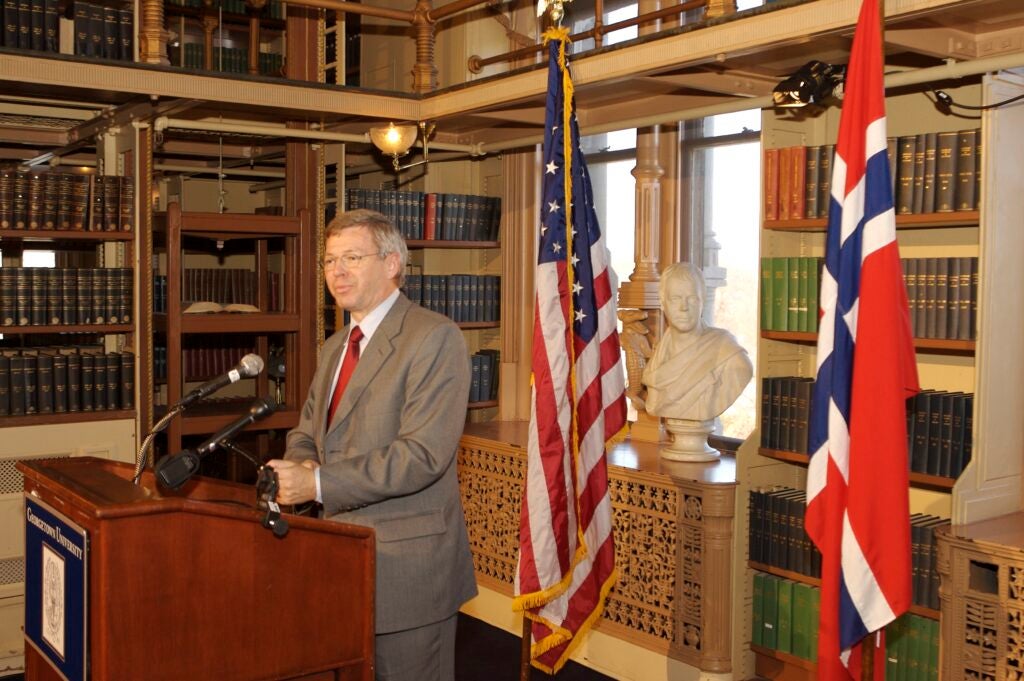
Prime Minister Kjell Magne Bondevik delivers his lecture titled “Interreligious Dialogue: Seeking Understanding in Our Age”, March 7, 2007.
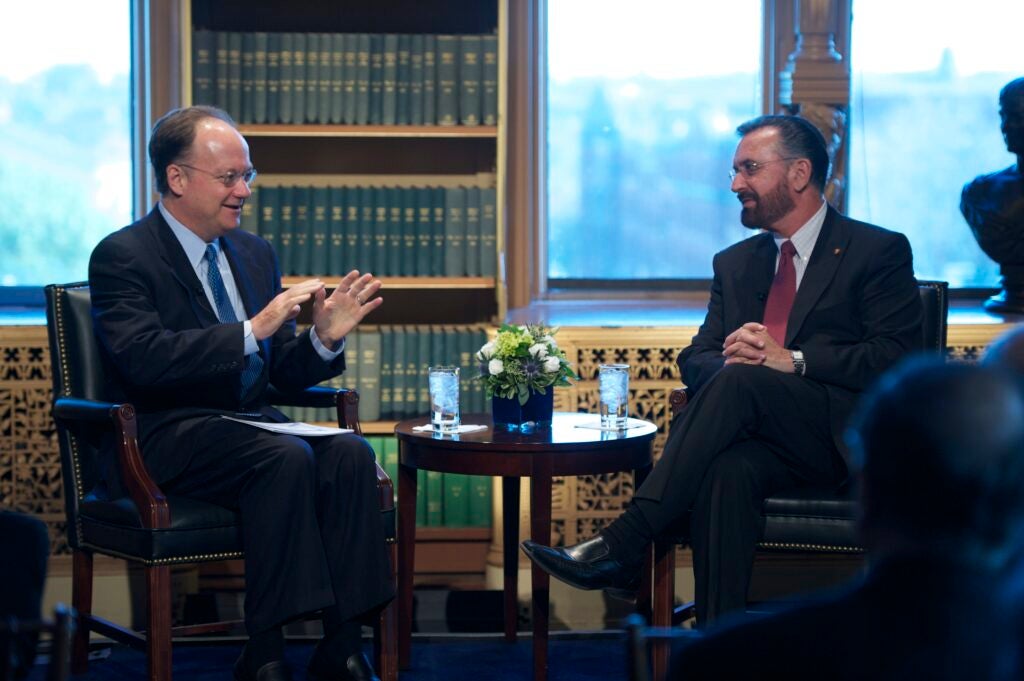
Then-President DeGioia and Rabbi David Rosen engage in conversation during the “Achievements, Challenges and Experiences in Catholic-Jewish Relations” lecture, November 6, 2012.
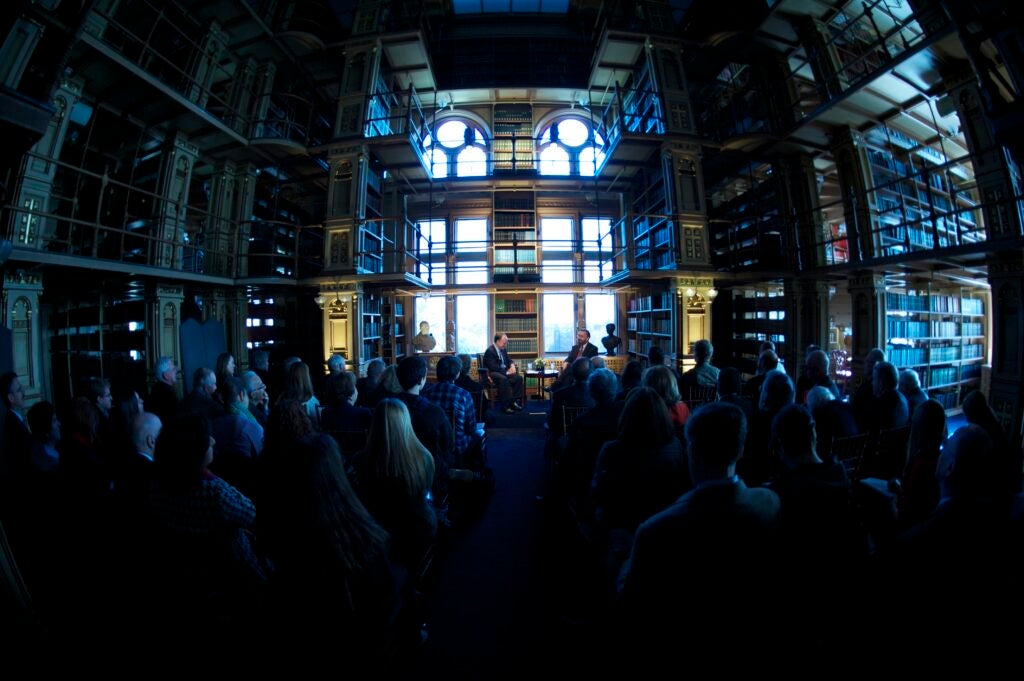
The “Achievements, Challenges and Experiences in Catholic-Jewish Relations” lecture with Rabbi David Rosen, November 6, 2012.