Pacem in Terris

In 1963 while the United States and its allies were locked in a Cold War showdown with the Soviet Union and its satellite nations, Pope John XXIII, a peacemaker of extraordinary influence, issued the encyclical Pacem in Terris, “Peace on Earth.” In this seminal document for world peace, Pope John XXIII called on all peoples to respect the human dignity of all persons and to begin an authentic dialogue in the quest for peace and human fulfillment.

Pacem in Terris Lecture Series

Inspired by the vision of Pope John XXIII, the Georgetown University established the Pacem in Terris Lecture Series. This series examined issues and prospects in the global imperative for peace with a series of presentations by distinguished scholars, religious leaders, and human rights activists from around the world.

The Pacem in Terris lecture series was a collaboration sponsored by the Office of the President, the Catholic Studies Program, the Center for Social Justice Research, Teaching and Service, the Office of Mission and Ministry, and the Woodstock Theological Center.

Speeches from the Pacem in Terris Lecture Series

The series, active from 2003 through 2006, featured global leaders and scholars addressing the Pacem in Terris document’s four pillars: Truth, Justice, Love, and Freedom.

  • Inaugural Lecture
    October 10, 2003
    Peter Steinfels, Fordham University professor and co-director of the Fordham Center on Religion and Culture

  • Panel Discussion: “Human Rights Are Best Served By Democracy and International Law”
    November 17, 2003
    • Cherie Booth, QC, leading human rights lawyer and wife of former British Prime Minister Tony Blair
    • Conor Gearty, Rausing Director of the Center for the Study of Human Rights and Professor of Human Rights Law LSE
    • Ambassador Michael Novak, Jewett Scholar in Religion, Philosophy, and Public Policy at the American Enterprise Institute
    • Jeane Kirkpatrick, former US Ambassador to the United Nations and Professor of Comparative Government at Georgetown University

  • Finding the Balance Between our Rights to Security and Liberty
    February 9, 2004
    Dr. William SchulzExecutive Director of Amnesty International

  • Analyzing Atheism; Unbelief and the World of Faiths
    March 29, 2004
    Dr. Rowan Williams, Archbishop of Canterbury

  • A World Without Poverty
    April 5, 2004
    Peter D. Bell, then President of CARE USA

  • A World of Conflict or a World of Law?
    September 30, 2004
    Shirley Williams, then leader of the Liberal Democrats in the British House of Lords

  • Memory, Salvation, and Perdition
    October 5, 2004
    Miroslav Volf, Henry B. Wright Professor of Theology at Yale University Divinity School and Director of the Yale Center for Faith and Culture

  • Lasting Roads to Peace
    October 14, 2004
    Andrea Riccardi, founder of the Community of Sant’Egidio

  • Towards a Just and Sustainable Peace
    November 15, 2004
    Jonathan F. Fanton, President, John D. and Catherine T. MacArthur Foundation

  • Doing What’s In Front of You: 20 Years of Humanitarian Response From the Ethiopian Famine to the Asian Tsunami
    February 8, 2005
    Ambassador Tony Hall, then U.S. Ambassador to the Agencies for Food and Agriculture (FAO)

  • Peace In The World: The Contribution Of Interreligious Relations
    February 28, 2005
    Archbishop Michael Fitzgerald, M.Afr., then President of the Pontifical Council for Interreligious Dialogue

  • Human Rights: The Basis for Peace on Earth
    September 19, 2005
    Rev. Cedric Prakash, S.J., Director of Prashant, the Ahmedabad-based Jesuit Centre for Human Rights, Justice and Peace

  • Liberals, Cannibals and Christians
    September 22, 2005
    Senator Marcello Pera, then member of the Italian Senate

  • Vital Strategies for a Global AIDS Response
    October 24, 2005
    Remarks by Fr. Robert Vitillo, Special Advisor to Caritas on HIV and AIDS

  • His Eminence Renato Cardinal Martino
    President Emeritus, Pontifical Council for Justice and Peace
    November 14, 2005


  • Dr. Charles Villa-Vicencio
    Executive Director, Institute for Justice and Reconciliation
    November 14, 2005

  • Mr. Stephen Lewis
    Then United Nations’ Special Envoy for HIV/AIDS in Africa
    January 25, 2006

  • Dr. Peter Piot
    Then Under-Secretary-General of the United Nations and Executive Director of the Joint United Nations Programme on HIV/AIDS (UNAIDS)
    March 7, 2006

  • The Honorable Roméo Dallaire
    Then Member of the Canadian Senate
    March 20, 2006

Pacem in Terris 50th Anniversary Conference

To commemorate the 50th anniversary of Pacem in Terris, Georgetown University hosted a conference on April 12, 2013, “Human Dignity in World Affairs: Celebrating Pacem in Terris and its Legacy.”
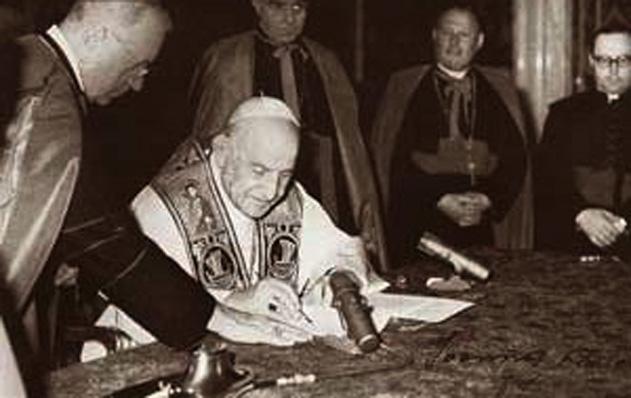
Pope John XXIII sits at a desk to sign papers.

Pope John XXIII promulgated Pacem in Terris, “Peace on Earth”, on April 11,1963, in the depths of the Cold War and after the Second Vatican Council had concluded its first of four sessions.

Released just weeks before his death but five months after the chilling standoff between President Kennedy and Premier Khrushchev in the Cuban Missile Crisis, the encyclical became the decisive last will and testament of Pope John and the charter Vatican II needed to embrace an agenda for peace, human dignity and human rights. Fifty years later, the ideas developed in Pacem in Terris retain their centrality for contemporary world affairs.

Pacem in Terris: Its Role in Catholic Social Teaching and its Impact on World Politics

Keynote Address

J. Bryan Hehir, S.J., John F. Kennedy School of Government, Harvard University

A New Language for Peace: the Origins and the Preparation of Pacem in Terris

Panel Discussion

Alberto Melloni, Maryann Cusimano Love, and Gerard Mannion

Moderated by John Borelli

Human Dignity in Contemporary International Affairs

Panel Discussion

Anthony Arend, Thomas Banchoff, Drew Christiansen, S.J., and Paula J. Dobriansky